
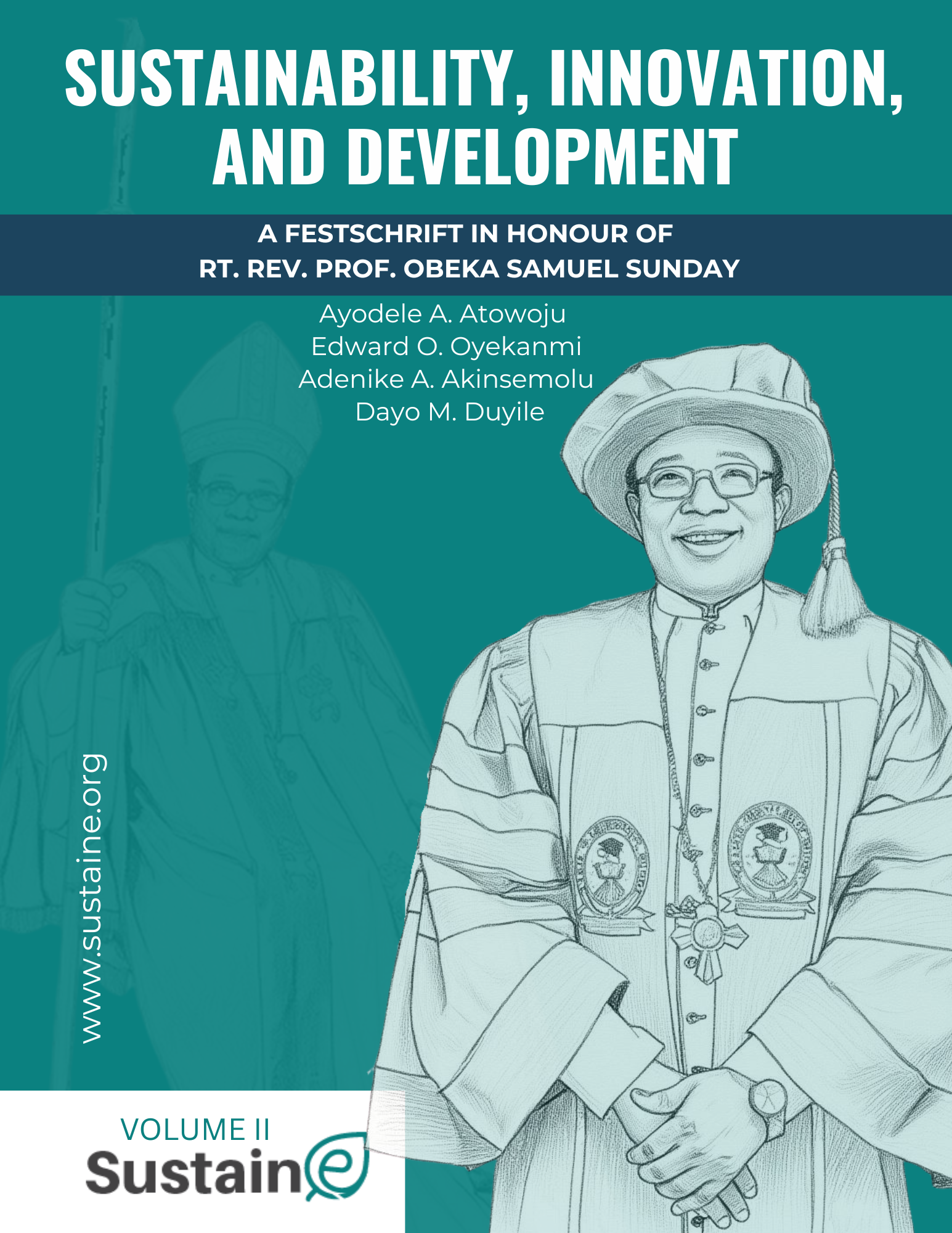
Reflections on Science, Service, and the Stewardship of Knowledge
DOI:
https://doi.org/10.55366/suse.v3i3.34Keywords:
Ethical leadership, Stewardship of knowledge, Community service, Transformational leadership, Faith-based higher educationAbstract
This reflective essay explores how scientific inquiry, ethical leadership, and community service can operate as a single, reinforcing model of academic leadership, using the career of Rt. Rev. Prof. Samuel Sunday Obeka as an illustrative case. As Vice-Chancellor of Wesley University, Ondo and a Methodist Bishop, Obeka embodies a dual identity that bridges scholarly rigor with faith-informed governance. The essay traces his commitment to knowledge creation and educational excellence, emphasizing his background in environmental science education and his leadership in expanding academic programs, strengthening research capacity, improving ICT and learning infrastructure, and pursuing strategic partnerships that enhance institutional quality and global visibility. Beyond institutional growth, the article argues that ethical leadership is the enabling condition that makes academic transformation credible and sustainable. It presents Obeka’s leadership style as values-driven and consultative, marked by integrity, transparency, inclusivity, and a servant-leadership orientation that prioritizes people, fairness, and accountability. The essay further positions community engagement as a defining measure of university relevance, highlighting outreach initiatives, health-related service linked to new health programs, entrepreneurship training, and development projects that generate local socio-economic benefits. Finally, the essay frames “stewardship of knowledge” as the responsible curation, application, and dissemination of both scientific and moral insight for the common good, illustrated through Obeka’s editorial experience, sustainability emphasis, mentorship, and efforts to institutionalize enduring systems for learning and research. It concludes that sustainable progress requires integrity, humility, and shared responsibility.
Downloads
Published
Issue
Section
Categories
License
Copyright (c) 2026 SustainE

This work is licensed under a Creative Commons Attribution-NonCommercial 4.0 International License.